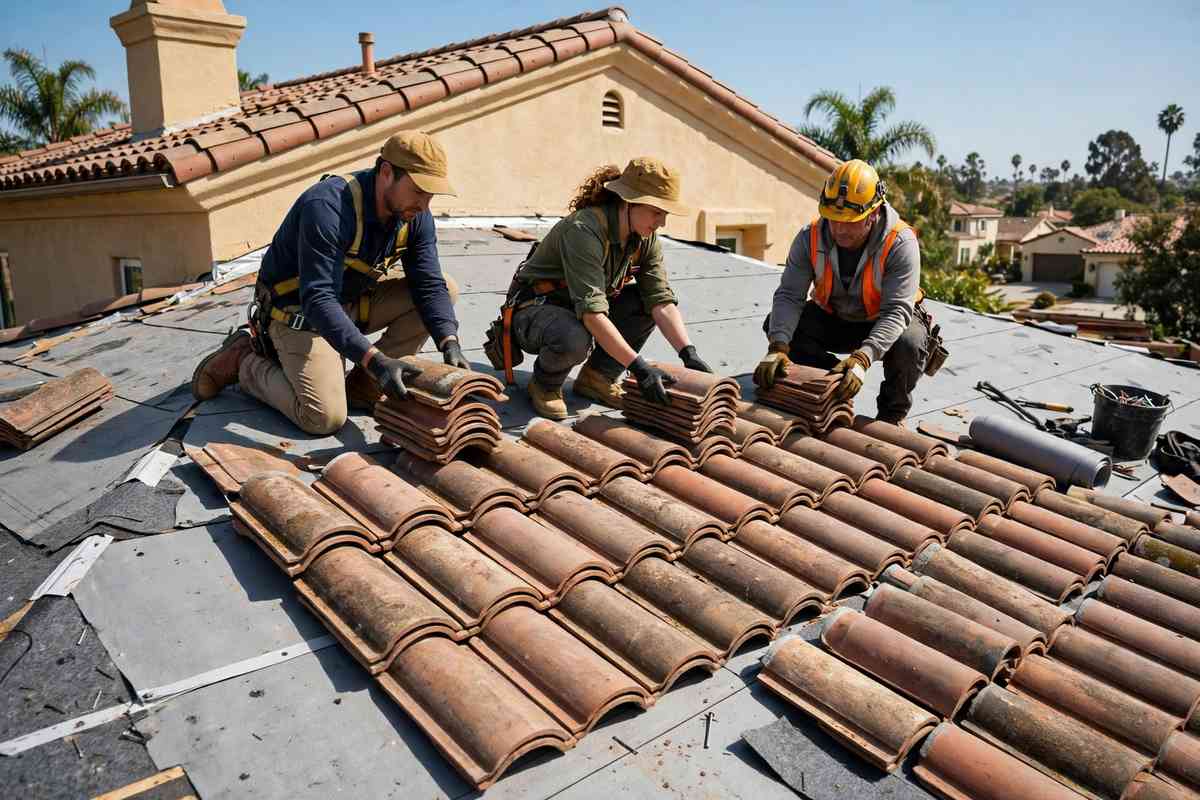
A commercial flat roof fails at seams, penetrations, parapets, and drains — not across the whole membrane at once. Repair makes sense when the membrane is sound and the failure is localised; replacement makes sense when seams are failing widely, drainage cannot be corrected, or the membrane has aged past repair. On the Sepulveda Town Center and Center Drive corridors, phased work keeps buildings trading while the roof is open. Related: flat roofing, commercial roofing, and Sepulveda Blvd Town Center.
Reading a commercial flat roof: where the decision is made
A commercial flat roof rarely fails all at once, which is why the repair-or-replace decision is made detail by detail rather than by age alone. The survey reads seams first, because a seam that has opened admits water along a line rather than at a point; then penetrations, where vents, curbs, and conduits break the membrane; then parapets, where the membrane turns up and flashing takes the weather; then drainage, because a flat roof that cannot shed water will fail at its lowest point no matter how sound the membrane looks elsewhere.
Membrane age matters, but it matters as a pattern, not a date. A membrane that is old yet still welded tight at its seams, with drains that clear and parapets that are flashed soundly, is a repair candidate. A membrane of any age whose seams are failing widely, whose drainage cannot be corrected without regrading, or whose parapet flashing has failed along a run is past the point where local repairs hold — each new repair only moves the failure to the next weakest seam.
Why phasing matters on the Sepulveda and Center Drive corridors
On the Sepulveda Town Center and Center Drive corridors, the roof is rarely the only system in play. A commercial building keeps trading, housing tenants, or running services while its roof is open, so work is phased: one area is opened, repaired or replaced, and made watertight before the next is touched. Phasing costs planning time up front, and it is what keeps a roof project from becoming a building-closure project.
The scope conversation for a commercial flat roof should therefore name the seams, the penetrations, the parapets, and the drains separately, and say which of them are repaired and which are replaced. A scope that only promises a new membrane, without addressing drainage or parapet flashing, leaves the two details most likely to fail the new work untouched. Permits for the address are confirmed before work starts, as with any Westchester roofing scope.
Questions readers ask
Can a flat roof be repaired in sections?
Yes, when the membrane is sound and the failure is localised to specific seams, penetrations, or parapet runs. Sectional repair stops making sense when seams are failing widely or drainage cannot be corrected, because each local fix then only moves the failure along.
Why does drainage decide so many flat-roof scopes?
A flat roof that ponds water fails at its lowest point regardless of membrane condition. If drains cannot be corrected, the scope has to address the drainage itself — regrading or new drainage — rather than only renewing the surface.